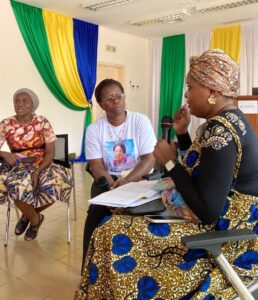
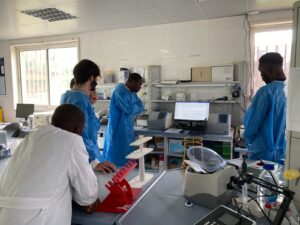
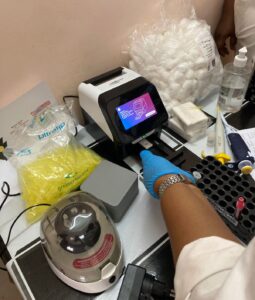
The EChiLiBRiST project officially launched Clinical Trial 1 (CT1) in Lambaréné, Gabon last week. Under the leadership of the Centre de Recherches Médicales de Lambaréné (CERMEL), the local team started recruiting patients at the Albert Schweitzer Hospital and the Georges Rawiri Regional Hospital Centre; a collaboration that leverages a long-standing research partnership. This trial launch follows the successful completion of comprehensive staff training and a site initiation visit.
The aim of CT1 is to assess a novel triaging approach for children with febrile illness in low-resource healthcare settings, with the trial already underway at the site in Mopeia, Mozambique. This strategy combines rapid biomarker-based testing with the standard of care to more accurately prioritise healthcare and improve clinical decision making.
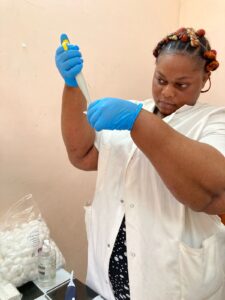
Capacity Sharing and Clinical Readiness
Five days of training were implemented by Dr. Pere Millat, David Torres, and Ivonne Torres on behalf of the consortium leaders from ISGlobal, alongside Dr. Rhode Matsanga, clinical coordinator and Dr. Agnandji, principal investigator from CERMEL. The sessions were attended by CERMEL coordinators, clinical staff, lab technicians, socio-behavioural sciences, and field coordinators from the health centres that will be collaborating on the clinical trial. They included reviewing the protocol and the standard operating procedures for study implementation in Gabon site.
After the training phase concluded, the monitoring team, ITClinical, conducted the site initiation visit. They confirmed that both the site installations and documentation meet all compliance standards, ensuring the trial’s readiness to operate under the highest safety and ethical standards. Final approval for patient enrolment was granted shortly after the CERMEL team successfully implemented the minor recommendations provided during the visit.
From Launch to Impact
The initiation of CT1 in Gabon reflects a culmination of hard work and an extraordinary collaborative effort between the on-site team and the EChiLiBRiST partners. With both CT1 sites operational, the project is making strong progress towards its goal of enhancing the triaging of febrile children in resource-limited healthcare settings, to improve health outcomes and save lives.
This project has received funding from the European Union’s Horizon Europe research and innovation programme under grant agreement No 101057114. Disclaimer: This reflects only the authors’ view and the European Commission is not responsible for any use that may be made of the information it contains.